Vedic astrology does not begin with star signs. It begins with the nine grahas - seven visible bodies and two lunar nodes - and asks what each one is doing in your chart: which house it occupies, which signs it rules for your ascendant, and whether it is comfortable where it sits. A "good planet" in a textbook can be a problem for a particular Lagna. A "malefic" in an upachaya house can build a career. Dignity and function come before nickname.
The seven that have a body
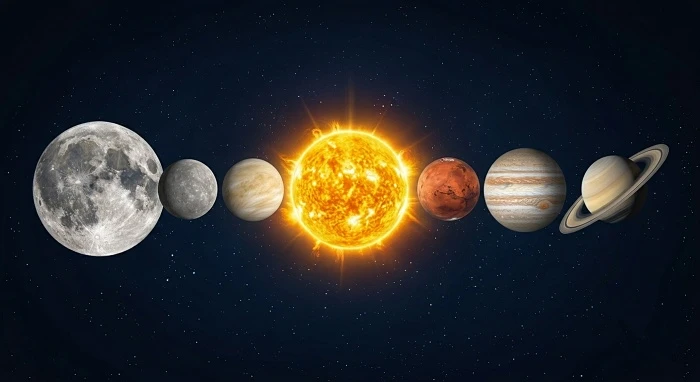
Surya (the Sun) is the soul, father, authority and vitality. He wants to be seen. In a kendra or in Leo he often describes someone who takes charge; combust and weak, he can describe someone who works under another person's name. Sunday and the metal gold are his.
Chandra (the Moon) is the mind, mother, and the way life actually feels day to day. The Janma Rashi is simply the Moon's sign at birth, and most Rashifal is read from it. A waning or afflicted Moon does not mean a weak person; it often means a sensitive nervous system that needs more rest than the chart's ambition wants to allow.
Mangal (Mars) is energy, siblings, land, surgery and conflict. He is the planet behind Manglik Dosha, which is a 7th-house conversation, not a character judgement. Own sign or exaltation makes him a builder; a badly placed Mars in the 1st or 8th needs an outlet that is not other people.
Budha (Mercury) is speech, trade, calculation and wit. He takes on the colour of whoever he sits with, which is why a Mercury–Saturn mix thinks slowly and a Mercury–Moon mix talks fast. He is at his worst when he has nothing to analyse.
Guru (Jupiter) is dharma, children, teachers and expansion. A strong Jupiter does not make someone rich by itself; it tends to make help, counsel and second chances available. Debilitated Jupiter still teaches - usually through a subject the person had to learn the hard way.
Shukra (Venus) is pleasure, arts, vehicles, spouse (for most charts) and the capacity to enjoy. In a dusthana he can still give talent; he just gives it with a cost. Venus and the 7th lord together say more about marriage than Venus alone.
Shani (Saturn) is time, labour, delay and the structures that last. He is the planet of Sade Sati, which is a transit over the Moon, not a life sentence. Where Saturn sits in the birth chart tells you which area of life will ask for patience. Where he transits tells you when that lesson is loud.
The two that do not
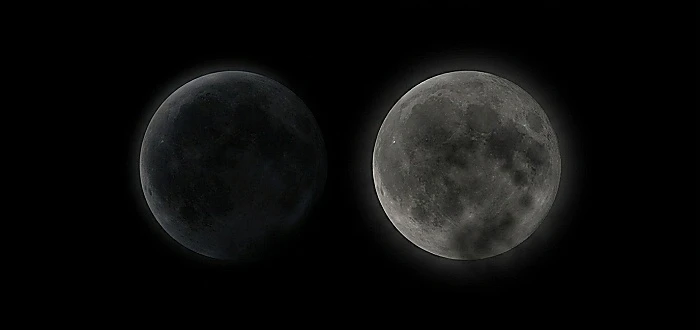
Rahu and Ketu are the lunar nodes - mathematical points, always 180° apart. They are not physical planets. Rahu amplifies, hungers and pulls toward the new; Ketu cuts, detaches and remembers. A separate guide to the nodes covers Kaal Sarp, eclipses and why the nodes should not be read as a horror story. In brief: treat them as a pair. One never acts without the other.
Dignity is not a moral score
A graha is exalted in one sign, in own sign in one or two, debilitated opposite its exaltation, and otherwise in a friend's, enemy's or neutral sign. Combustion (too close to the Sun) and a war with another planet (graha yuddha) further change how cleanly it delivers. None of this means "good person" or "bad person". It means the topic that planet rules arrives easily, late, loudly, or through other people.
Worse: a planet that is exalted by the book can still be a functional malefic for your Lagna if it rules a dusthana. Mars as 6th and 11th lord for a Gemini ascendant is a different Mars from Mars as 5th and 10th lord (yoga karaka) for a Cancer ascendant. This is why a gemstone chosen from a Sun-sign column is a poor idea, and why the gemstone calculator starts from your actual Lagna lords.
Pick a graha. Gold is exaltation, a gold ring is own sign, grey is debilitation.
Then pick a Lagna to see which houses this graha rules.

Mangal (Mars)
Exalted in Makara, own sign in Mesha and Vrishchika, debilitated in Karka.
For Karka Lagna, Mars rules the 5th and 10th - yoga karaka.
A dignity map, not a reading of your chart. Combust and retrograde change the sentence, not the strip. For your own grahas, use the Kundli Maker.
Retrograde, combust, and "weak"
A retrograde graha is not broken. In the classical view it often works inward or repeats a theme until it is learned. Combustion hides a planet under the Sun's glare - speech (Mercury) and comfort (Venus) are the ones people notice first. A "weak" Shadbala score is a research note, not a verdict; plenty of functioning lives have a planet that looks tired on paper and still does its job in dasha.
To see the nine together, generate the chart on the Kundli Maker and read the planetary table: sign, house, dignity, retrograde and combustion. Then look up who is transiting you now on the current transit page. Birth-chart dignity is the instrument. Transit is the weather.