
A Kundli - also called a Janam Kundali, birth chart or horoscope - is a map of the sky at the exact moment you were born, drawn from the point on Earth where you took your first breath. In Vedic astrology it is the foundation of every reading: your personality, relationships, career, health and the timing of major life events are all read from this single diagram. This guide explains, in plain language, what a Kundli actually is and how to begin reading your own.
How a Kundli is created
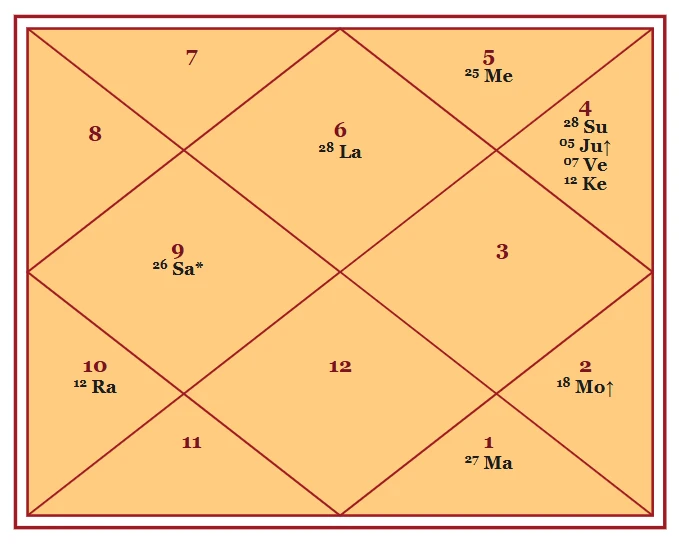
Three pieces of information are needed to cast an accurate Kundli: your date of birth, your exact time of birth, and your place of birth. The date and time fix where the planets were in the zodiac, while the place fixes the horizon - which decides your rising sign. Even a difference of a few minutes can change the ascendant and shift the entire house structure, which is why the birth time matters so much.
From these three inputs an astrologer (or a calculator like our free Kundli Maker) computes the sidereal positions of the nine planets, the ascendant, and the twelve houses. Vedic astrology uses the sidereal zodiac with the Lahiri ayanamsa, which tracks the stars as they actually sit today - this is why your Vedic Moon sign is often different from the Sun sign you read in a newspaper.
The twelve houses (Bhavas)
A Kundli is divided into twelve houses, each governing a different area of life. The first house (the ascendant or Lagna) represents you - your body, temperament and how you meet the world. Tap a house on the diamond to read what that bhava rules. The numbers on the chart are house numbers, not signs.
Tap a house. The numbers here are house numbers, not signs.
1st - Lagna, body and direction
House 1 of 12. The top diamond is always house 1.
The person as they meet the world: vitality, appearance, temperament and the plot of the life.
A learning map of the twelve bhavas. It does not use your birth details. For a chart of your own, use the Kundli Maker.
In short, moving around the chart, the houses cover:
- 1st house - self, health, appearance, overall vitality
- 2nd house - wealth, family, speech and food
- 3rd house - courage, siblings, effort and communication
- 4th house - mother, home, property, inner peace
- 5th house - children, intelligence, romance and past-life merit
- 6th house - enemies, debt, disease and daily work
- 7th house - marriage, spouse and partnerships
- 8th house - longevity, sudden events, inheritance and the occult
- 9th house - fortune, dharma, father, higher learning and long journeys
- 10th house - career, status, authority and public life
- 11th house - gains, income and fulfilment of desires
- 12th house - loss, expenses, foreign lands, sleep and liberation
Whenever a planet sits in a house, or a house's lord is placed elsewhere, it colours that area of life. Reading a chart is largely the craft of tracing these connections.
The signs and the planets
Each house is occupied by one of the twelve Rashis (signs), from Mesha (Aries) to Meena (Pisces), and each sign is ruled by a planet. The nine Grahas - Sun, Moon, Mars, Mercury, Jupiter, Venus, Saturn, and the lunar nodes Rahu and Ketu - each carry a nature and a set of significations. The Sun is authority and the soul; the Moon is the mind and emotions; Jupiter is wisdom and expansion; Saturn is discipline, delay and hard-earned reward. A planet's strength depends on the sign it occupies (its dignity), the house it sits in, and the company it keeps.
Your Moon sign (Janma Rashi) is especially important in Vedic astrology - most predictive work, including your daily Rashi reading and Dasha periods, is measured from the Moon rather than the Sun.
How a Kundli predicts timing
A birth chart shows potential, but Vedic astrology adds a second layer - Dasha, the planetary period system - to show when that potential unfolds. The most widely used is Vimshottari Dasha, a 120-year cycle in which each planet rules a stretch of your life in turn. A promising career combination, for example, tends to deliver most strongly during the Dasha of the planets that form it. Transits (gochar) of the slow planets, especially Saturn and Jupiter, fine-tune the timing further.
How to start reading your own chart
Begin with the basics before diving into technique:
- Find your ascendant and its lord - this sets the tone for the whole chart.
- Locate your Moon and note its sign and house; this is your emotional core.
- See where the benefics (Jupiter, Venus, well-placed Mercury and Moon) and malefics (Saturn, Mars, Sun, Rahu, Ketu) fall.
- Check which house each planet rules and where that ruler is placed.
You can generate an accurate, free chart with our Kundli Maker, which also lists your running Vimshottari Dasha and a full Panchang for your birth day. If you want practical spiritual guidance based on the chart, the Kundli Remedy tool suggests mantras, gemstones and daan mapped to your planetary positions.
A note on interpretation
The astronomy behind a Kundli is precise, but astrology is interpretation. A chart describes tendencies and timing, not fixed fate - free will, effort and remedies all shape how the potential plays out. Treat your Kundli as a map that helps you make better decisions, and consult a qualified astrologer for the big questions in life.