A Kundli is twelve rooms around a person, not twelve personality types. Each bhava (house) is a department of life. The sign that occupies it, the planet that rules that sign, and any graha sitting inside it together describe how that department tends to go. The rooms themselves do not move. What moves is which sign sits in the first house - that is the ascendant (Lagna) - and therefore which planet becomes the landlord of each room.
Until you know the houses, a planet in "Leo" tells you almost nothing useful. Leo in the 10th is a public life; Leo in the 12th is a private one. The same planet, two different lives. That is why this site's Kundli Maker always shows house numbers beside the signs.
Four groups the classics actually use
Astrologers do not treat all twelve houses as equal. Four groupings turn up in almost every reading:
- Kendras (1, 4, 7, 10) - the pillars. Self, home, spouse and career. Planets here act in the open.
- Trikonas (1, 5, 9) - dharma and grace. Intelligence, children, fortune, teachers. A planet well placed here is usually a help.
- Dusthanas (6, 8, 12) - friction, shock and loss. They are not "evil houses". They describe effort, transformation and what you spend or release. A strong 6th can win a fight; a weak 6th can become one. Named cautions that use these rooms (and others) are unpacked in what a dosha actually means.
- Upachayas (3, 6, 10, 11) - growth through effort. These tend to improve with age and work. Malefics here often perform better than they do in a kendra of comfort.
The 1st house sits in both kendra and trikona, which is one reason the Lagna and its lord outweigh almost every other single factor. Raja yoga is the named use of those two groups - see Raja Yoga: kendra, trikona and the yoga karaka.
What each house rules
Tap a house. The numbers here are house numbers, not signs.
1st - Lagna, body and direction
House 1 of 12. The top diamond is always house 1.
The person as they meet the world: vitality, appearance, temperament and the plot of the life.
A learning map of the twelve bhavas. It does not use your birth details. For a chart of your own, use the Kundli Maker.
1st - Lagna, body and direction
The person as they meet the world: vitality, appearance, temperament and the "plot" of the life. A dignified Lagna lord is the single best support a chart can have. A badly placed one does not cancel the rest of the chart, but it does mean effort has to work harder.
2nd - speech, family money, food
Accumulated resources, the family you were born into, and how you speak. It is not "income" (that is closer to the 11th). A harsh 2nd lord can make speech blunt; a well-placed Venus or Jupiter here often shows a household that eats well and talks well.
3rd - courage, effort, younger siblings
Initiative, short journeys, skills of the hands and the will to try again. Mars likes this house. A quiet 3rd can still succeed, but usually through persistence rather than a first attempt.
4th - home, mother, inner peace
Property, vehicles, the mother, and whether the person feels settled. The Moon is the natural karaka. A disturbed 4th does not mean a bad parent; it often means restlessness about belonging, or a life that keeps changing address.
5th - intelligence, children, romance
Poorva-punya (the credit of past effort), speculation, mantra, and children. A strong 5th helps study and judgement. It does not, by itself, promise a child - the 5th lord, Jupiter and the dasha have to agree.
6th - work, debt, illness, opponents
Service, daily grind, loans, and the people who oppose you in the open. A capable 6th lord can make an excellent employee, doctor, lawyer or someone who wins disputes. A weak 6th tends to collect unfinished tasks.
7th - spouse, partners, the public
Marriage, business partners, and how you meet "the other". Venus is the natural karaka; the 7th lord and the Darakaraka refine the picture. Matching two 7th houses is a different job from Guna Milan, which only compares Moons.
8th - longevity, other people's money, the hidden
Inheritance, research, sudden change, and what is not said aloud. It is also the house of shared resources in a marriage. A loaded 8th is intense; it is not a death sentence, and classical texts never read it that way in isolation.
9th - dharma, father, fortune, teachers
The luck that feels undeserved, long travel, faith, and the father or guru. Jupiter is the natural karaka. A strong 9th does not make someone pious; it often makes help arrive when it is needed.
10th - karma, status, the work the world sees
Profession, reputation, and the kind of effort that gets a name attached to it. The Sun and Saturn both have a say here. The 10th is what people remember; the 6th is the job that pays the bills. Many charts have both, in different measures.
11th - gains, friends, fulfilment
Income, networks, elder siblings, and desires that actually arrive. A link between the 10th and 11th is the classical picture of a career that also pays. A busy 11th without a backbone 10th can be social without being secure.
12th - loss, sleep, foreign lands, release
Expenses, isolation, ashrams, hospitals, and life far from the birthplace. It is also the house of letting go. A 12th-house emphasis is common in charts of people who live abroad, work nights, or give a lot away - not only in charts of "loss".
How to use this on your own chart
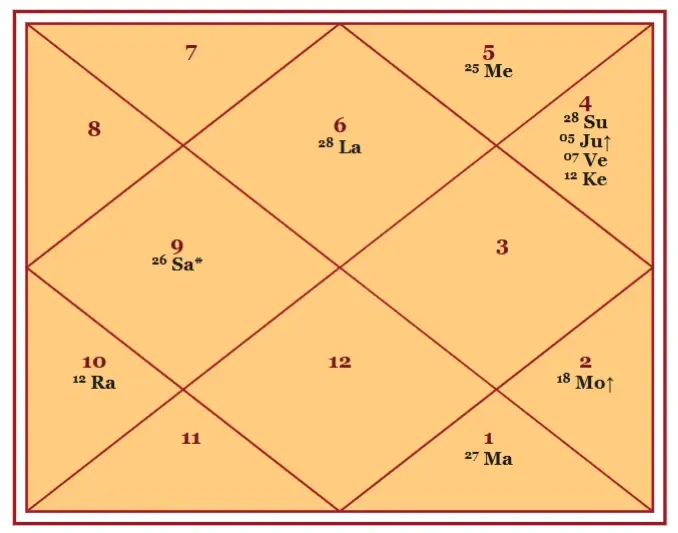
Open the Kundli Maker with an exact birth time and a city from the list. Find the Lagna, then walk the twelve houses anti-clockwise on a North Indian diamond (or left-to-right on a South Indian square). For each house, note the sign, the lord, and who sits there. That walk, done slowly, is most of beginner chart reading. The guide to reading a birth chart puts this sequence in order with the planets and dashas.
A house with no planets is not empty of meaning. Its lord still acts from wherever that lord sits. An "empty 7th" with the 7th lord in the 10th often describes a marriage that is lived through work and public life. Do not skip empty houses.